RESTORING AND MAINTAINING EYESIGHT. Professor Sheng Lim is an internationally renowned ophthalmologist and consultant at St Thomas’ Hospital in London. He was trained in the UK and also spent one year as the International Glaucoma Association’s postdoctoral fellow at the Mayo Clinic, Minnesota. He was promoted to Professor of Ophthalmology (Glaucoma Studies) at King’s College London in 2020, in recognition of his contribution towards ophthalmology research. He is currently the head of ophthalmology research at St Thomas’, and founder of their KCL Frost Eye Research Department, one of the largest ophthalmology clinical trial units in the UK.
You can listen to the podcast of this interview here.
Professor Sheng Lim, what is the difference between an oculist, an ophthalmologist and an optometrist?
Oculist is an older, traditional term, generally replaced by “ophthalmologist”. Although it is still used in specific instances (e.g. the Royal Family’s ophthalmologist in the UK is called the King’s Oculist). Optometrists are opticians who primarily test vision and prescribe glasses, while an ophthalmologist is a trained medical doctor specializing in eye care. They can perform the same functions as an optometrist (testing vision, prescribing glasses) but are also qualified to treat eye diseases and perform surgery. In some U.S. states, the distinction between optometrists and ophthalmologists is becoming less defined as optometrists are now allowed to perform some procedures and treat certain conditions.
When did you decide to be an ophthalmologist?
I decided to specialize in ophthalmology during my final year of medical school, an experience that deeply moved me. I observed a patient’s joy after cataract surgery restored their vision. Seeing the immediate and significant improvement in their quality of life, achieved through a relatively quick procedure, sparked a passion within me. I knew then that I wanted to dedicate my career to ophthalmology.
“My ultimate goal, as a professor in glaucoma research, is to find a cure for glaucoma and prevent blindness.”

Dr Sheng Lim performing a glaucoma surgery
Sheng Lim, you specialize in treating glaucoma and cataracts. What is the difference between these two eye diseases?
Both cataracts and glaucoma are major causes of blindness. A cataract is a clouding of the natural lens in the eye, which can be corrected with a relatively straightforward surgical procedure. Glaucoma is different; it’s a condition where the pressure inside the eye damages the optic nerve, potentially leading to irreversible vision loss. Cataracts cause blurry vision, while glaucoma often has no symptoms until significant damage has occurred. Factors like age, UV exposure, and certain medications can contribute to cataract formation.
Are cataracts easier to correct now than when you started?
Absolutely. Cataract surgery in the UK is now a highly successful and common procedure. We use a modern technique involving a small 2mm incision. An ultrasound probe breaks up and removes the cloudy lens, which we then replace with a foldable plastic lens injected into the eye.
How long does the cataract operation last and is it very delicate?
The operation is usually completed in under 20 minutes and is very successful. We use operating microscopes and modern machinery that make the surgery quick and safe.
What is glaucoma?
Glaucoma happens when the pressure inside your eye gets too high, which can hurt the optic nerve – the “cable” that connects your eye to your brain. If you don’t treat it, glaucoma can slowly make you go blind.
Is glaucoma an aging disease?
Glaucoma is more common as you get older. The drainage system in your eye can start to clog up, causing pressure to build. This is why it’s more often seen in older people. It’s not common in young people, unless they have a specific genetic condition that makes them more likely to get it.
How do you detect glaucoma?
The tricky thing about glaucoma is that it usually doesn’t cause any symptoms until it’s advanced. That’s why it’s important to be proactive about your eye health. If you’re over 40, make sure you see an optician for regular checkups that include glaucoma screening. And if you have a family history of glaucoma, it’s even more important to get checked regularly – ideally, once a year.
When does glaucoma have to be operated on instead of medicated?
Most glaucoma patients can be treated with eye drops or simple laser procedures to manage their eye pressure. However, if these treatments stop working, or if your eye pressure continues to rise despite them, surgery may be necessary to protect your vision. In general, about 20-30% of people with glaucoma will eventually need surgery.
“Vision is probably one of the most intimate and important sensory organs that a human being has.”
Sheng Lim, how do glaucoma surgery and cataract surgery differ?
Cataract surgery involves replacing the natural lens with a plastic one. Glaucoma surgery is different – it is a procedure to drain fluid from the eye, by either placing a small tube or creating a small hole, to reduce pressure. Glaucoma surgery is more complex than cataract surgery and has a higher risk of complications. Because of this, we only advise patients to have glaucoma surgery after they have tried drops and laser treatment first.
Are there possible complications of eye surgery?
While cataract surgery is very predictable, there can be some complications to glaucoma surgery, but the serious ones are rare. The most common thing that can happen is that the pressure in your eye can drop too low. Fortunately, serious complications that cause blindness are rare – less than 1 in 100. Most problems are temporary, like a little bit of bleeding, and your doctor can usually fix these easily.
Does surgery permanently cure glaucoma?
The goal of glaucoma surgery is to create a stable, long-term solution by establishing a new drainage channel in the eye. When successful, this allows for a perfect equilibrium of eye pressure. While this can last for many years, it’s important to understand that, unlike cataract surgery, the new drainage channel can sometimes become blocked due to scarring or inflammation. So while surgery can provide long-term control, it’s not always a guaranteed permanent cure.
How long is the recovery from these eye operations?
After cataract surgery, you can expect a very quick recovery and be back to your normal activities in a few days. Glaucoma surgery takes a bit longer to recover from, with your eyes taking a few weeks to stabilize, usually between 2 and 6 weeks. You’ll likely wear a patch on the first day. Most people will have blurry vision for a week or two, but be back to normal by 4-6 weeks.
Is there a lot of psychological fear in patients when they know that they have eye disease?
Absolutely. Vision is probably one of the most intimate and important sensory organs that a human being has. The thought of losing vision can be very anxiety inducing, rightly so. Glaucoma damage is an irreversible process, so even if you have successful glaucoma surgery, it doesn’t bring back the vision, so you want to do the glaucoma surgery before it causes blindness. The psychological acceptance of having glaucoma surgery can be quite difficult for patients to accept. When I do cataract surgery you can see better, but the idea of doing glaucoma surgery is not that we’re going to improve your vision, it is to try to save you from going blind in five or ten years’ time. This is why we only offer to do glaucoma surgery to our patients whose pressures are too high despite medication drops.
Is it a dream to cure blindness?
I would like to believe that a cure for blindness is possible. But this is likely difficult. We would have to regenerate the cells that give you vision. These are programmed not to grow, and this is why glaucoma is hard to treat. Neurons from the nervous system don’t regrow very well, so transplants or making new connections are very difficult.
Could it be possible to invent a virtual way of seeing using technology?
The brain generates images from neuron signals it receives. There are existing devices that stimulate the occipital lobe to mimic image generation. However, currently these images are very crude and don’t replace real vision. I think it’s possible to eventually achieve virtual vision, but it will take time for artificial light signals to be generated in the brain so that you can perceive even 40-50% of what humans can see. Currently, this technology creates minimal shadows of images and lacks the clarity necessary to make a real difference.
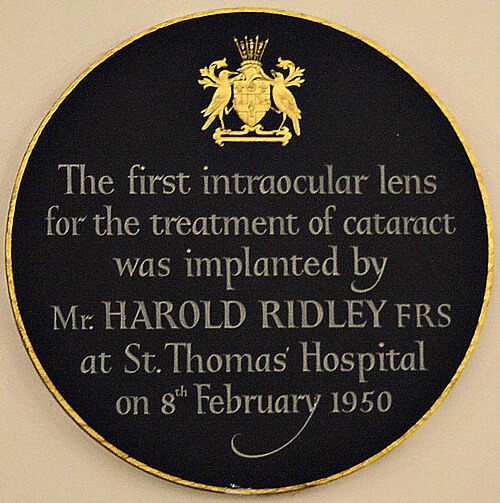
The plaque at St Thomas’ Hospital, London, in honour of the pioneering surgeon Sir Harold Ridley, internationally known because he was the first person to invent a plastic lens in the 1950s to put into a patient’s eye to replace the natural cataract.

Official opening of the Frost KCL Eye Research Department in 2015

Dr Sheng Lim and his team at St Thomas’ Hospital in 2022


Dr Sheng Lim Chair and Keynote Speaker at Cairo meeting in February 2025

Dr Sheng Lim chairing a Glaucoma Surgery meeting in Paris February 2025
“In the UK and Europe we have more choices, better suited for the patients, than they have in America.”
Sheng Lim, is your ultimate goal that one day people will not go blind?
Yes, absolutely. My ultimate goal, as a professor in glaucoma research, is to find a cure for glaucoma and prevent blindness. While I am pessimistic I can achieve it in my professional lifetime, I am encouraged by the new glaucoma surgeries coming through. But surgery or the new implants are still not without risk of complication. It would be nice to have a glaucoma surgery that is just as successful as a cataract operation.
Who improves the surgery techniques?
Improvements in surgical techniques come from a variety of sources: small companies, startups with innovative ideas, and researchers developing new implants. These are tested on animals and then humans in small studies. I often get involved at an early stage, working to ensure the implant works in our population and can be approved for general use.
Is the state of ophthalmology much the same everywhere and its success just a question of the quality of the doctor?
While a skilled doctor is crucial, the state of ophthalmology isn’t exactly the same everywhere. Leaving aside countries with lower GDP, you have some subtle differences in terms of glaucoma quality services. The key difference is the availability of glaucoma implants and drops. In the UK and Europe we have more choices, better suited for the patients, than they have in America.
Environmental factors affect some cancers. Is this also the case for glaucoma?
Environmental factors may increase the risk of glaucoma, but these factors are not as big an influence as for something like cancer. Age and genetics are much more important. While things like UV light or pollution might increase the risk, the evidence is not strong.
Does being in a multi-cultural city like London affect your practice?
Yes, being in a multicultural city like London significantly affects my practice. Our glaucoma surgery population at St. Thomas’ is very complex compared to more homogenous populations, which is why we attract trainees from around the world.
Do racial factors affect the incidence and treatment of glaucoma?
Absolutely, race is a very important factor. Black patients, especially those of West African and Afro-Caribbean origin, have a significantly higher risk – four times higher – of developing glaucoma compared to European populations. Sadly, surgery is also less effective in these patients because of a tendency to form aggressive scars, this aggressive healing process is similar to keloid formations in the skin, so scarring in the eye stops the glaucoma surgery from working. This underscores the need for tailored treatment approaches and further research into these disparities.
Do your black patients have a similar type of glaucoma to the European population?
Black patients have a type of glaucoma (Primary open-angle) similar to the European population. However, they often develop the disease at a younger age and have a higher risk of surgical failure. East Asian patients, such as those of Chinese, Mongolian, and Burmese descent, are more prone to Angle-closure glaucoma, different from the open-angle glaucoma more common in Europeans. This is why glaucoma treatment is so often race-specific.
Is there anything that can be done to lower the risk of glaucoma?
Unfortunately, it is a condition that can cause you blindness, without you realising it. In a final word, I want to say it’s very important for people who are at risk of developing glaucoma – either they are getting older or they have a family disease of the condition, or they are black or Afro-Caribbean – they must go to see an optician regularly every year to make sure that these conditions are picked up before the damage has occurred. Because once the damage is done it is largely irreversible. You cannot bring sight back.
Sheng Lim, thank you very much.
All images courtesy of Sheng Lim.
ENJOY THIS INTERVIEW? SHARE IT WITH A FRIEND.