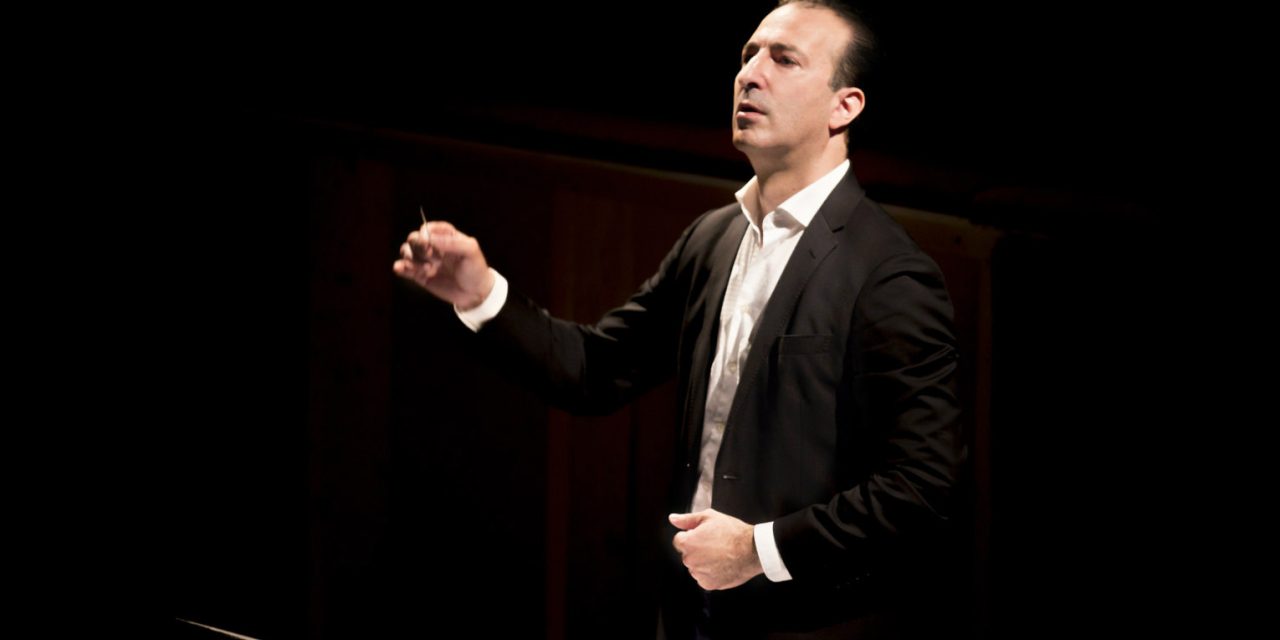
ITALIAN OPERA IS IN THE AIR. Alvise Casellati was born in Padua, Italy, from a Venetian musical family with important ties to the top classical music scene in the 19th and 20th centuries. He is currently serving as Artistic Director of the Teatro Massimo of Palermo, one of the most prestigious opera and dance theaters in Italy and in the world. He is the Founder and Music Director of Opera Italiana is in the Air (OIA), created in 2017 to bring superstar singers and the young talents in iconic locations in the air such as Central Park, New York, to give everyone the opportunity to appreciate Italian Opera.
19 minutes read time.
You can listen to the podcast of this interview here.
Alvise Casellati, how is it for you to be in Palermo?
Palermo is a fascinating city, a true melting pot of many different styles and cultures due to its history and cultural influences, from Anglo-Norman architecture to New Gothic, Neoclassical, and the very first example of Liberty Style in Italy. In addition to its beauty, when I arrived last May I could immediately feel the energy of a city that is growing. The same feeling I had about Miami in the early 2000s when Art Basel arrived there and the city grew, becoming a major cultural centre. Palermo lived a period of glory at the time of the Belle Epoque from 1870 until the first world war, when families like the Florio’s helped the growth. It’s the period when Ernesto Basile, a pioneer architect of the Liberty style, was asked to build Teatro Massimo. Another period of cultural growth was from 1950s/1970s. I feel that today this phenomenon is present again. A lot of people today are relocating from France, the UK, Germany, because of Palermo’s quality of life and cultural vivacity due to its tremendous intellectual level. The locals look at Teatro Massimo as a myth, as the centre of cultural gravity in Palermo. The theater’s size also commands this respect (about 7,730 square metres).
Is Teatro Massimo as big as La Scala in Milano?
It’s the biggest in Italy and largest in Europe but has less seats, around 1,280. In the last years, the theater is generally always full. The average is around 92% occupancy per performance, which is very high. People come from all over world, especially in the summer season, but you might be surprised that from November to March the theater is also completely full.
“The locals look at Teatro Massimo as a myth, as the centre of cultural gravity in Palermo.”

Photo by Holger Uwe Schmitt
Alvise Casellati, is Palermo an increasingly popular international tourist destination?
Yes, and that also contributes to international visits since the theater is visited as a monument regardless of the programming. Palermo is one of most important tourist spots and the airport numbers grew to an all-time high of over 9 million passengers in 2025. Palermo is fully booked from Easter until the end of October and the number of visits to the theaters are exponential.
How did your tenure as the Artistic Director of Teatro Massimo begin in 2025?
We presented the new season at the end of July 2025; when I joined the theater at the end of May there was still some substantial work to be done to shape this season. I was able to do that with my General Manager, Marco Betta. We built a phenomenal season and I’m now working on the 2026/27 season and 2028 is almost done as well.
What kind of operas do you like to be performed? Italian, German, Austrian?
Music is music. Of course opera was invented by the Italians 500 years ago but we always try to include a combination of many aspects. This year we will open the season with a beautiful French opera title that has not been at Teatro Massimo for over fifty years. We will have a combination of operas that are less performed and operas that are very much loved by the people. Every year you try to have a title like Tosca and Traviata, because a title like that is a big hit.. Then operas that are more researched and less performed. Looking forward, contemporary is also the target that the general manager and I have in mind. Without contemporary works, our world will not survive. We just had a beautiful production of Semiramide, an opera that lasts four hours. It’s also very important to keep operas like this alive because if theaters don’t book these operas anymore (being afraid of their length), we will lose an amazing repertoire.
Do you conduct in Teatro Massimo?
No, I am the Artistic Director and I have different roles. I am very glad to report that orchestra and choir are at a very high artistic level. I would say top tier.
There are very many opera theaters in cities all over Italy. How do they all survive?
There is a big interest from abroad to attend Italian opera in Italy. Everybody knows that these theaters have gravitas in the way we rehearse and our level of perfectionism. Furthermore, Palermo also has another peculiarity. We have a separate theater called Brancaccio where we build and design the scenes. There are painters and artisans working there every day. It’s something unique that is disappearing little by little, and it’s something that needs to be kept alive.
Is your public young or old?
It’s very mixed. Thank goodness that Palermo has a great balance and you see a lot of young people. In other theaters in Italy I have not seen the same interest from young people that Palermo has. This is also due to the fact that Teatro Massimo is heavily invested in training the young generations. But generally in Italy opera theaters are attended only by the older generations.
Is this because opera is something that is quite old-fashioned?
Your parents would not have said so. Our generation has come to the conclusion that opera is something where young people don’t go. It’s not true. The Conservatory of Music keeps graduating people that are in their 20s and they’re playing in the orchestras and competing to enter these great institutions, like Teatro Massimo. The theater is also greatly invested in the young generations. Finally, speaking about aesthetics, I don’t think there is another theater that has this incredible beauty both outside and inside. This makes it one of the most beautiful in the world.
Is it very difficult to gain admission?
Super difficult. We have very severe entrance competition, and sometimes we don’t award a seat when we don’t find the right level. There are instruments that keep going empty because we’re not reaching that level.
“We wanted to give young people and people who could not afford to go to the Met Opera the opportunity to fall in love with Italian opera”
Alvise Casellati, you are also Director of Opera Italiana is in the Air (OIA) which performs in Central Park, New York, so you are also busy in the summer in the United States?
Let me connect this to my experience at Teatro Massimo. Opera Italiana is in the Air was created in 2017, so next year will be the 10th. OIA is a format that I developed in conversation with Daniele Bodini, the Chairman of the Foundation for Italian Art and Culture (FIAC). We wanted to give young people and people who could not afford to go to the Met Opera the opportunity to fall in love with Italian opera, to experience this treasure, so we created a free concert to attract as many people as possible. We have striking testimonies of what opera caused to first time listeners if you visit OIA’s website.
Are you the conductor of OIA?
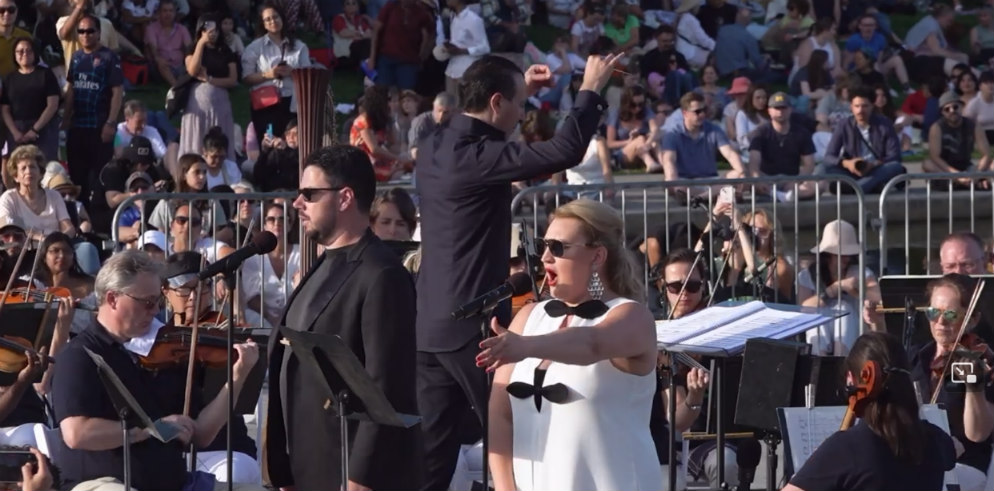
Yes, I founded OIA and perform as the conductor, creating an orchestra formed from the Met Opera and New York Philharmonic, but also incorporating young students from Juilliard, and Manhattan School of Music where I studied conducting. When I was studying at Columbia Law School, I played violin in an orchestra of both students from Manhattan School of Music and Juilliard School of Music.
You’re a maestro of violin, and you play piano too?
Yes, I graduated as maestro of violin from the Padua Conservatory, in Italy. I did the old conservatory system, so ten years while I was doing normal school. You also have to study three years of piano, because violin does not have all the notes and piano does. So it’s very important to visualize and understand on the piano the full piece that you are going to perform. Piano is a fundamental instrument.
Is the first violin in an orchestra also a conductor?
No. The concertmaster is the representative of the orchestra with whom the conductor shakes hands when he enters, because he is the most important figure in the orchestra. Other key instruments are the oboe (that gives the A to the first violin to tune the orchestra), the first horn and the first cello.
More or less how many people attend?
In Central Park thousands of people and in Washington, D.C. we reached between five and ten thousand last time. An amazing crowd. We are going to do it again in 2026 on May 31st in Washington D.C. and September 21st in Central Park for the International Day of Peace.
How many people make up an opera orchestra?
The size changes. In baroque music sometimes you only have strings, while in Wagner, Puccini, Strauss, etc. you have a larger orchestra. It also depends on how many strings you place, because usually the wind instruments and the percussionists are written specifically by the composer, but not the size of the strings. That makes a difference in the size of the orchestra. In Palermo we have 104 members of the orchestra, which is the second largest after La Scala.
And how many when you conduct in New York? Can you tell me more about your OIA events?
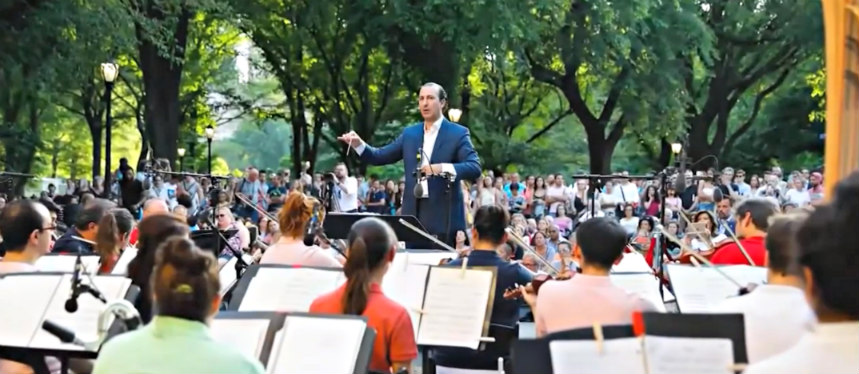
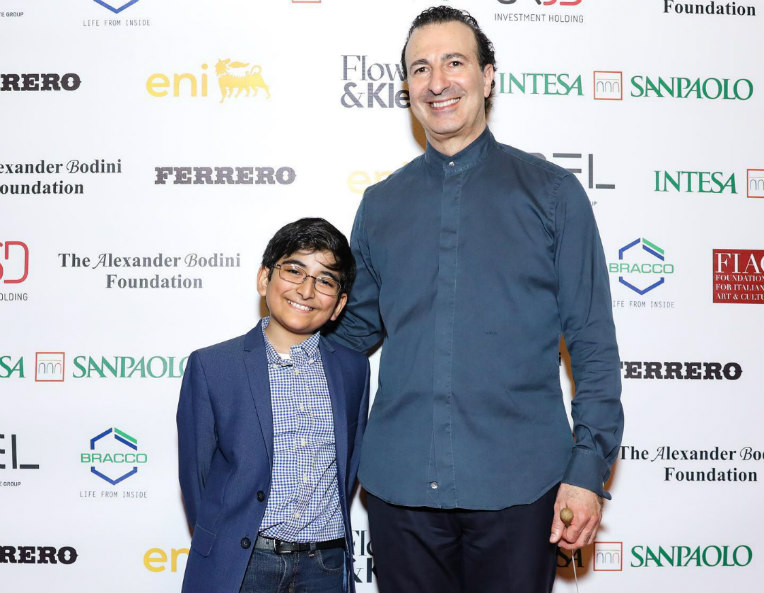
We have 60 people in the orchestra in the open air. I try not to make Opera Italiana is in the Air only a musical event, and I also have other parts. For instance, I invite young composers aged 12 years old to 18 years old in the pre-college class from Juilliard School of Music to join a blind competition. Juilliard sends me their scores, the partituras, and I analyse them and determine who is the winner. Only after I decide the winner do they tell me the name of the composer, the age and the biography. I don’t want to be biased in any way by anything other than the music.
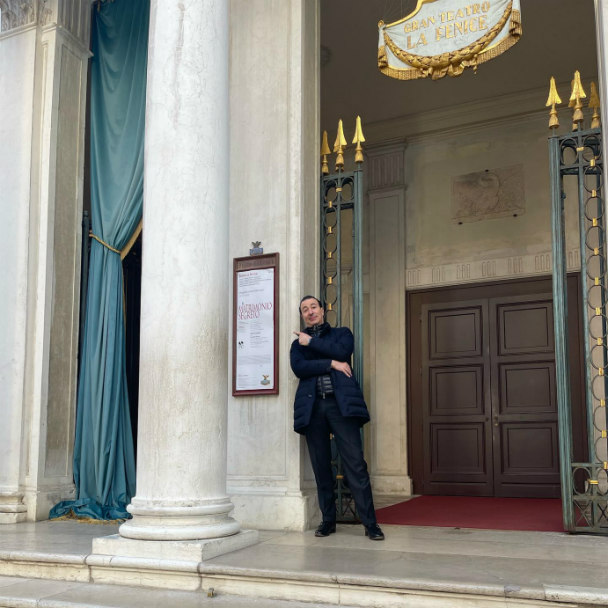
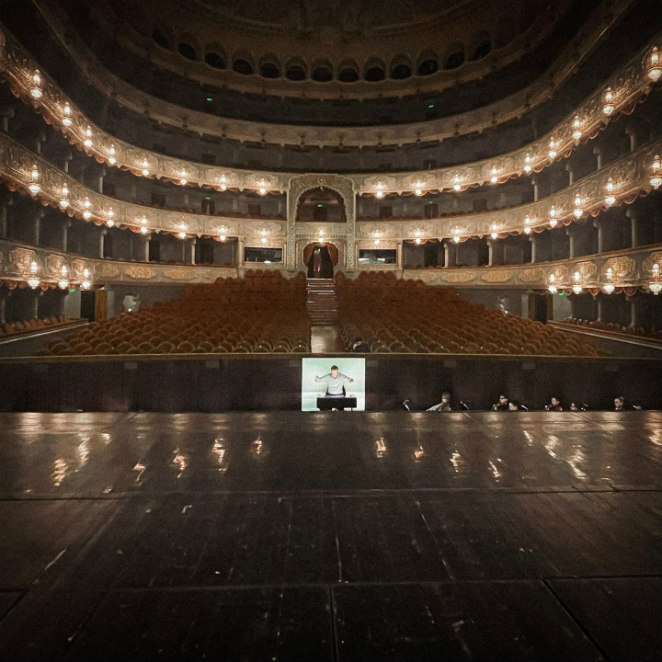
“What I adore about this theater is the investment in the young generation.”
Alvise Casellati, do you only do Opera Italiana is in the Air in New York, or also in other parts of America?
Four years ago I started doing the same thing in Washington, D.C. at Lincoln Memorial, an incredibly iconic location. One big component of our program is the attraction of the youth by employing the youth and giving an opportunity to the young generation. Another component is music therapy, and we work with Memorial Sloan Kettering Cancer Hospital and their choir of cancer survivors. After they win this challenge of cancer, they find a cure in singing in a choir. I employ their choir to sing the U.S. National Anthem at the beginning of my concert, and this has created a common project that we have over the years.
And in Washington D.C.?
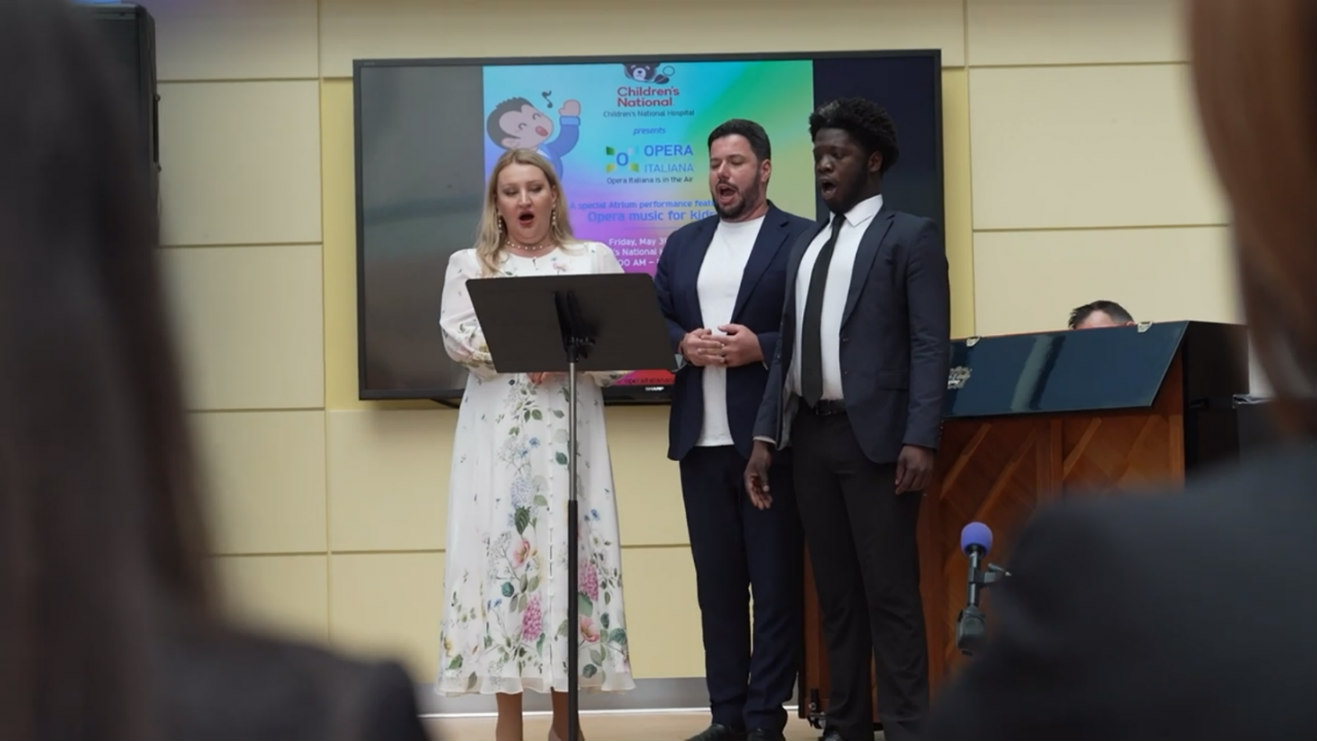
In Washington, D.C. we have a collaboration with the Children’s National Hospital, one of the top five American hospitals for children. The concert is streamed from the Atrium of the hospital to the rooms of the ill children. Their parents usually attend the concert and this has given so much relief from anxiety and pain. This is another very important project, where music is changing the quality of life of these people who have no hope.
Is there great passion among the people who you work with, the singers and the musicians and the conductors and the theater?
Of course. First of all, the level of commitment that classical music and opera commands is so high that unless you do it for passion, you would not do it, because you don’t find billionaires working in the opera world. The billions are inside of your soul.
There is one striking sentence that you read when you enter Teatro Massimo in Palermo: “L’arte rinnova i popoli e ne rivela la vita. Vano delle scene il diletto ove non miri a preparar l’avvenire“ (“Art renovates the people and it reveals their life. Where the arts do not prepare for the future, everything is made in vain.”). For instance, Verdi, one of our Risorgimento heroes, put sentences in the text of the operas that were supposed to encourage people to fight for their freedom and against the foreign conquerors, i.e. in Attila and in Nabucco.
Opera is sophisticated, but it’s made for everyone?
Yes, it is for everyone, because at the very least it’s great entertainment and at the highest level it’s a deep cultural experience, based on your preparation. Even for the ones who are not prepared and do not know the arts, it provides the very first seed of culture.
People can become very fussy about singers?
In certain theaters, the public can be very cruel. Like in any field of life, some people pretend to understand. I have to say that sometimes the opinion of somebody who does not have music preparation is more interesting to me: either music pierces your heart or it does not. The artist must give something to the public and the applause is the moment of reward providing the thermometer of success of the hard work of the artist. There were times when I attended concerts with great orchestras but walked out completely empty. Other times walking out flying, lifted, as if the earth was not under my feet, feeling very happy. I remember asking my teacher why that happened and he said: “Because sometimes there are people who communicate, with great perfection, nothing.” And that’s why you feel nothing. People with no preparation are able to perceive only this. They either receive or not. They don’t have bias.
You also conduct symphonic concerts, and do you like that?
That’s very important to keep the level of the orchestra high, because in the opera preparation a long time is spent connecting the stage with the pit, and sometimes you focus on the stage more than the orchestra. In symphonic concerts, you’re only focusing on making the orchestra work to perfection, so symphonic concerts are also very important, but it’s also a different specialty. At Teatro Massimo we try to do more repertoire that is typical of opera, and symphonic concerts, like choral concerts, or film music associated with watching a movie. We showed Visconti’s Il Gattopardo last year, with the orchestra playing the music live. It was an amazing experience for me to see Sicilians look at how Visconti saw Sicilians in the past. These amazing scenes where you fall in love with Sicily only looking at the first scene of the movie of Il Gattopardo and, despite the fact that it’s a very long movie, you could not get off the chair. You had to stay there because you were drawn in and this is what happens when the genius is there. Even if an opera is long, the genius of Verdi, of Puccini, of Rossini, of Donizetti, of Bellini, and the level of the singers keeps you glued to your chair. And Mozart, of course. We have a large orchestra, so we do Mozart. When we shape the season, we try to give many elements, some Baroque, some Bel Canto, some Verismo, some Puccini, as well as some operas that are never performed. We try to find a balance and we send a message. Last year, the message was feminicide. We opened with Aleko and Pagliacci, very movingly directed by the great director Silvia Paoli, who showed the 75 stabs of feminicide that happened in Italy, sending a message through opera. The mission of opera is basically to tell us who we are and who we should not be.
Do you have a favourite opera?
It’s always the next one on the programme of Teatro Massimo. As a conductor I am more into Verdi, Puccini, and of course Verismo. I love those operas where there is great passion. I cannot say one preference of Bel Canto right now, but I love a lot of things for different reasons and they resonate more or less in my personality. For the programs in the park famous arias from Rossini, Verdi and Puccini must always be there, depending also on what the singers who I choose can sing. Some singers sing Bel Canto and they don’t sing Puccini, and depending on the repertoire we build a concert.
Do you love your job?
It’s a dream. As you know, I used to be an attorney in New York. I was happy, but I thought I could be happier doing something that fed my soul. It is a great honour for me to be in Palermo, to be Artistic Director of such an important theater and it’s also a great responsibility to make it fly, to make it go higher and higher, and always think about what you can do next to serve your theater. What I adore about this theater is the investment in the young generation. It is of the utmost importance to pay attention to and invest in the younger generations. Teatro Massimo takes this task very seriously. We have a Kids Orchestra formed of 120 young children (age 7-17), a Youth Orchestra formed of 80 children (age 16-26), a Cantoria formed of 38 children (age 16-26) and White Voice Chorus formed of 38 children (age 7-16). It is a statement of the commitment of this theater to the younger generations and consequently to the future of classical music and opera. Furthermore, this is quite unique for the whole of Italy. Apart from the Academy of Santa Cecilia in Rome, I’m not aware of any other lyrical institution cultivating so much talent. The skill of these children is so high that when they are included in adult productions — i.e. “Tosca” or “La Boheme” — conductors, stage directors, and the public are very much impressed with them and their artistic results.
Do you have musicians who come from other countries?
We have a few Americans, British, a French violinist who just joined the orchestra. People move happily to Palermo, and in October we will hold competitions to enter the theater. A lot of young people will come and compete to enter this amazing orchestra and choir.
Alvise Casellati, thank you very much.
ENJOY THIS INTERVIEW? SHARE IT WITH A FRIEND