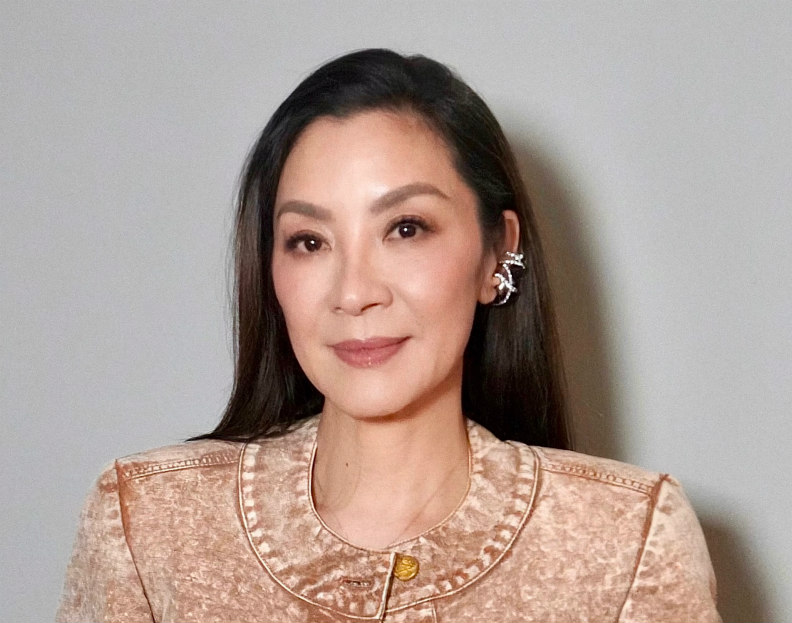
FEARLESS, ALWAYS EVOLVING. Michelle Yeoh, the Malaysian actress born in 1962, is considered to be one of the greatest female action movie stars. In a career spanning over four decades, she has acted in film and television productions covering a wide range of genres and received various accolades. Yeoh gained global recognition in the James Bond film Tomorrow Never Dies (1997) and starred in Ang Lee’s Crouching Tiger, Hidden Dragon (2000). Her versatility continued in Memoirs of a Geisha (2005) and The Lady (2011), a biopic about Aung San Suu Kyi. In 2023 she became the first Asian performer to win the Academy Award for Best Actress for Everything Everywhere All at Once (2022) and she received the Honorary Golden Bear for lifetime achievement at the 76th Berlin International Film Festival in February, 2026.
26 minutes read time.
You can listen to the podcast of this interview here.
Michelle Yeoh, when you were 15 you left home and went to ballet school in England but developed a condition which prevented this career. What happened?
The dream was to be a ballet dancer and I had dreams of having my own school. I took an extended holiday and by the time I went back to school I had missed the warm up classes, which is not a very smart thing to do. When you’re 16 and foolish you dive straight back into all those big classes, and it started off with a bad pull in the muscle. Ballerinas have always been taught to work through pain. We stand on tiptoe! I thought that it was just a little muscle pull, but it got progressively worse until my vertebrae rotated on the spine and I needed intervention.
Nevertheless, you remained a very active sporty person and even had a brief career as Miss Malaysia?
That was hardly a career! That was a mother move. My mother had all these great fantasies for me and wanted me to be Miss Malaysia.
She was right.
Well, yes. She’s always right. Moms are always right!
“When I set out to do a movie, the main intention is to do a good movie, to be very satisfied that it’s something that you will be proud of.”
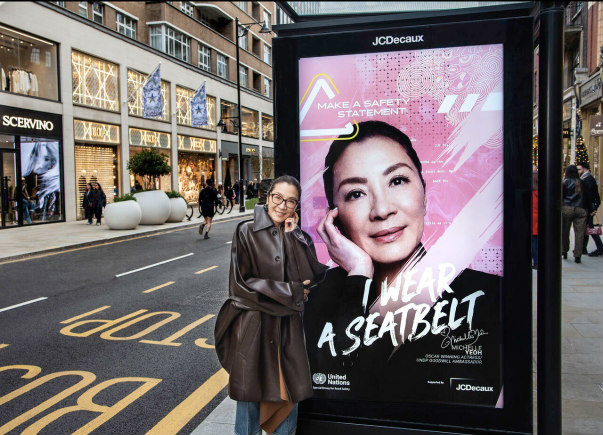
As the United Nations dedicated Global Road Safety/UNDP Goodwill Ambassador, Michelle Yeoh has spent over a decade collaborating on international awareness initiatives — such as the “#MakeASafetyStatement” global campaign with JCDecaux.
Michelle Yeoh, in Hong Kong between 1980 and 1990 you became a famous actress, especially in action and martial arts. Were you very strong?
I was. Because of my dancing and sports background I was able to adapt and learn martial arts. The first movie that I was involved in, I played the normal damsel in distress role. The guys were the ones who had all the moves and always rescued the girls. As I watched them do the fighting in the martial arts, I saw it was all about choreography, about movement, and it looked very much like dance, so I thought maybe I could venture and try something in that field.
But you didn’t want stunt men. You were very tough and did it yourself?
I retrained my body. Injury doesn’t incapacitate you forever as long as you learn how to evolve and develop and strengthen all the weaker parts. I ventured into modern and contemporary dancing, which used a very different set of muscles and movement, which helped when I wanted to venture into the martial arts world. I had an agreement with myself. Either you do it properly or you don’t do it at all.
Very few actors do that?
They’re a good crazy bunch of us. There’s Jackie Chan, Jet Li, Yun Piu, Sammo Hung. Quite a few of the very amazing action actors do their own stunts, but they were also classically trained in martial arts. I was fearless, I will give myself that, but I also I wanted to prove that girls are able to step up when it is necessary. The standard was so high in Hong Kong and the audience was so in tune with who were the real thing doing stunts and who wasn’t the real thing. It set the bar, and I felt that if you wanted to play in the boys’ group, you should at least pretend to be as good or close to one of them.
Later, the famous director Ang Lee worried about you doing stunts?
I did Crouching Tiger Hidden Dragon with Ang in 2000, so I had done a whole scene of my martial arts career, but by the time I did Crouching Tiger Ang was annoyed when people said I was just an action actor. He said, “You also have to come to terms with the fact that you are an actor.” Roger Spottiswoode who was the director of Tomorrow Never Dies said the same thing to me. “I don’t need you to do the stunts, because our insurance would definitely not allow you to do any of the crazy stunts. I need you to be an actor. I can always double you, but I can’t double you when it comes to the acting part.” I had these two very good directors who kept reminding me: It’s all about the acting, it’s not just about the stunts.
With Everything, Everywhere, All at Once, in 2023 you won the Oscar for Best Actress, a first for an Asian actor, probably because you were a good actress!
Thank you. I’ll take that. That’s very kind of you. A lot of the Asian actors and actresses have not really been appreciated in many of the incredible movies, like for example Zhang Yimou did, Chen Kaige did, even before and after Crouching Tiger. Even when it was Crouching Tiger we got nominated for Best Director, Best Film, best Director of Photography; best everything – except for Best Actors! None of my colleagues were even close to being nominated.
Did you ever think you were going to be an Oscar winner?
No, I don’t think that ever crossed my mind. When I set out to do a movie, the main intention is to do a good movie, to be very satisfied that it’s something that you will be proud of. The target is never that this is an Oscar movie, and also at that time we were not privy to having a seat at the table, per se.
You also made history as the first Malaysian to receive a star on the Hollywood Walk of Fame.
Yes, and I’m very happy to say that following after, and even before, there are many, many more Asians who have their star.
“The movies and the characters that I have done are not the same, and I tried my very best to do that so that I am constantly evolving and learning.”
Michelle Yeoh, has your global success changed you as a person?
I don’t think so. I work just as hard. I try still as the best that I can. All the accolades are not just for one movie. It’s an accumulation of all the work that I’ve done in the last 40 years. The Walk of Fame star or the Berlinale Honorary Golden Bear, all this is acknowledgement from my peers and colleagues that we see you, we have a seat for you at the table and you’re part of the whole family. That’s the most important thing, and it’s definitely given me more opportunities, but also the bar has been set even higher than it’s ever been. Luckily, I’m still fearless and I’m not afraid to fail, because, as we all know in the business, there is no guarantee that even when you do your very best from script to filming to promotion to when the movie is out, that it will be a success.
Your 40-year career is exceptional. Already in 2011 you had a very important role in The Lady by Luc Besson. You interpreted Aung San Suu Kyi, the winner of the Nobel Peace Prize who brought democracy to Burma. This was a very intense movie, and your acting was really important.
Thank you. I’ve been very blessed to work with amazing geniuses and talents, especially in directors and writers, and they have brought forward subject matters that many have to have the courage to tell these kind of stories. I was very fortunate: Memoirs of a Geisha (2005) with Rob Marshall, Sunshine (2007) with Danny Boyle, then The Lady (2011) with Luc Bresson. It’s a privilege to be able to learn and work with these amazing directors because they don’t stop teaching you. As an actor and as a storyteller you have to keep learning.
What do they teach you?
Your craft, which is broken down into so many components. It could be the rhythm, it could be the timing; there are so many moving parts that happen at the same time. I’m not a technical person so I don’t go into how the camera works or which angle. I have trust in the way my storytellers make their images work. They set the tone, and I am one of their tools. I am an actor, and that is what I enjoy the most; and also as a producer – I do enjoy that part as well.
How do you prepare to put yourself into the character of someone like Aung San Suu Kyi, a real person of such importance?
When it is a real person there’s a lot of research. She was still under house arrest when we decided to embark on the journey to tell the story about her. Her late husband’s twin brother and the family wanted very much the story to be told as well. It’s very hard to tell a story like that about a living person without the support of the family, to just run away by yourself and pretend that you know everything, so that was tremendous in contributing for both Luc and myself to have a much better understanding of where she came from and who she is. Obviously at that time we were not able to meet with her because she was under house arrest, and her family hadn’t even seen her in almost 8 years. People who remembered her actually hadn’t seen her in possibly 15 years, so their own memories are very selective, so I spent many, many hours just watching videos of her, because she did a huge campaign when she was running for democracy for her people at that time before her house arrest. I watched and tried to understand where she was coming from, and during her interviews she talked extensively about people who inspired her, who her heroes were, what kind of books she read. While she was under house arrest she always listened to the BBC radio, so sound was her doorway out into the world and she was able to live in her mind. She is very strong. You have to be, and you must learn to enjoy your own company and the company of your books, because that’s all you have. She was kept very isolated, so prepping for her took us a long time, at least the duration of when we picked up the script, to preparing and to getting the permits to be able to film, to going to Burma, to have a feel of the place and the people, what she was fighting for, why it was so important for her. We have great respect for the story.
You were in this very intense and dramatic role and then starred in Star Trek: Discovery from 2017 to 2020. How important is it for an actor to move from one kind of role to another very different kind?
It’s very important to find roles that are different and challenging, because then you’re out of your comfort zone, in something that you’ve not done before. The movies and the characters that I have done are not the same, and I tried my very best to do that so that I am constantly evolving and learning. Giving my audience something new to discover at the same time with me is not easy. It’s very easy to slip into a character that you know well. Star Trek was fun because the character evolved from this very heroic, everybody wants, Captain Philippa Georgiou, into the Emperor Georgiou who was terrifying and from the mirror-universe, so it gave me a lot of things to explore. Whenever I take on a script to read, I try as best to see as an audience: would I want to see something like this? Would it intrigue me, thrill me, give me some kind of emotion? Of course, if it was a director that I wanted to work with, I would try very hard to find something in the role that would be very exciting.
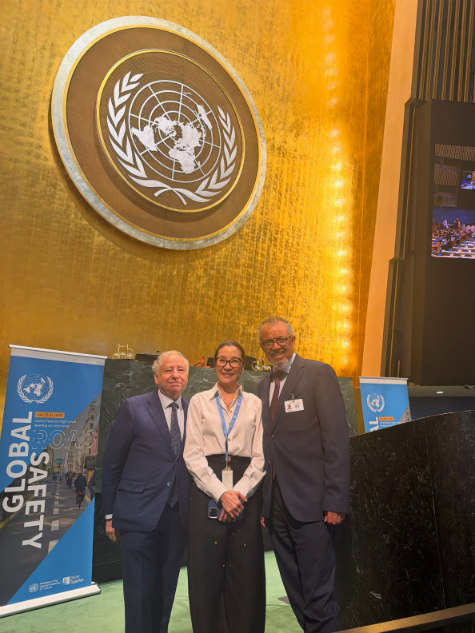
Michelle Yeoh and her husband Jean Todt are both prominent global advocates for road safety, combining their respective platforms in entertainment and motorsport leadership to combat what they describe as a “silent pandemic” of road traffic fatalities and injuries.
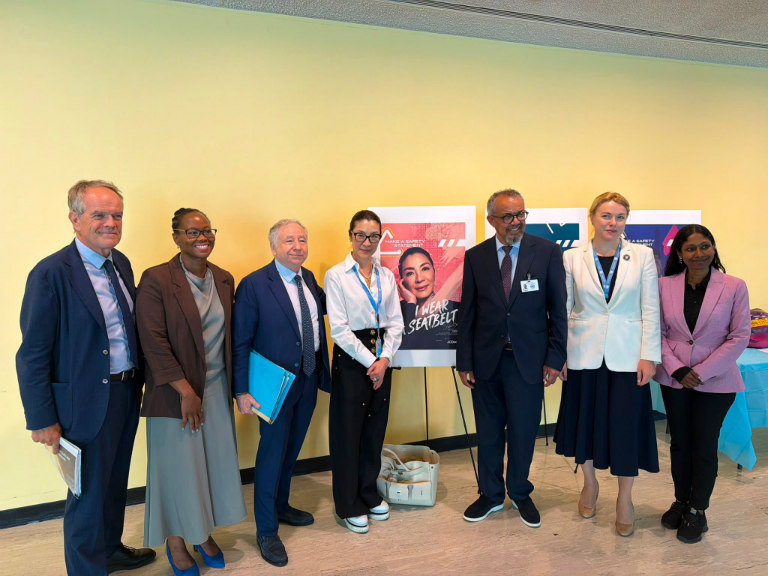
Global Road Safety is a collaborative effort
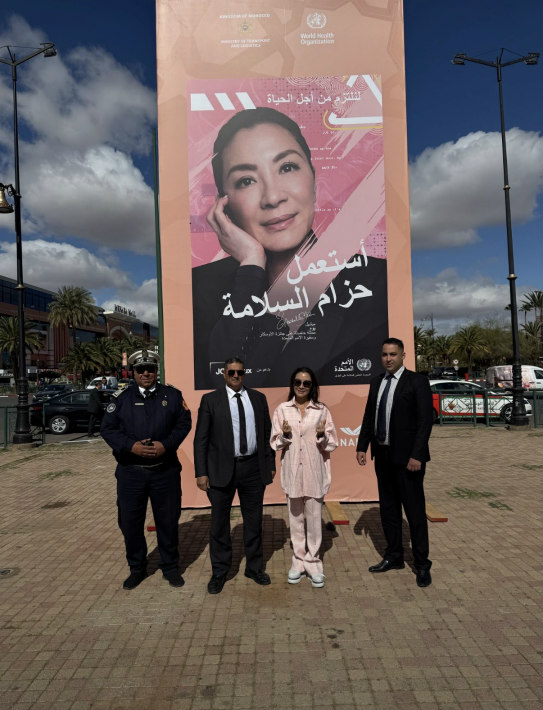
Campaigning for Global Road Safety knows no boundaries.
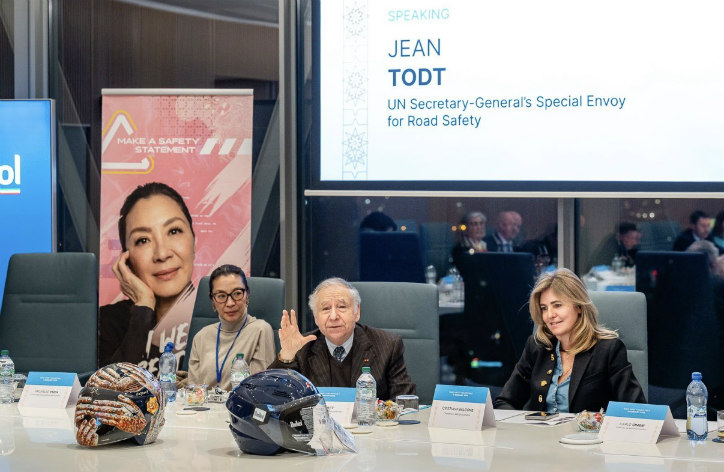
The high-visibility Global Road Safety initiative led by Jean Todt and Michelle Yeoh aims to halve the number of road-related deaths by 2030 as part of the UN’s Second Decade of Action for Road Safety. Road traffic crashes stand as the leading cause of death globally for children and young people aged 5 to 29, claiming roughly 1.19 to 1.4 million lives every year
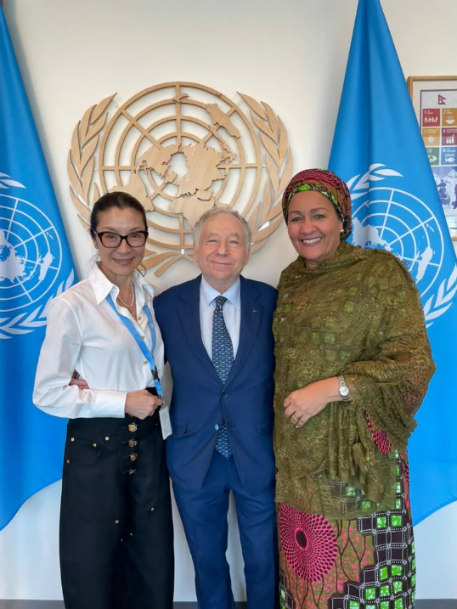
Michelle Yeoh and Jean Todt, UN backed Global Road Safety campagners
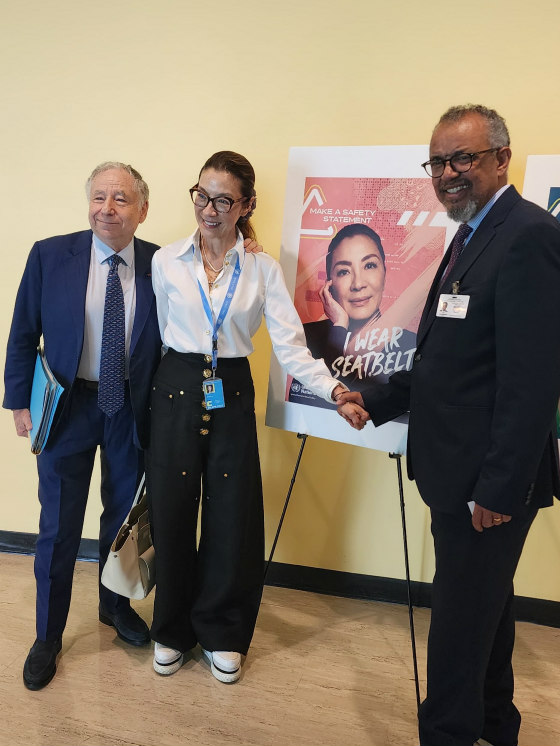
Jean Todt and Michelle Yeoh maintain a long-standing partnership as prominent advocates for Global Road Safety.
“I do believe that the harder you work, the luckier you become, so that when the opportunity does arise you are prepared for it.”
Michelle Yeoh, you are married to a Frenchman, Jean Todt. You received the prestigious Commander de la Légion d’honneur. You had the American Presidential Medal of Freedom and are among Time Magazine’s 100 most influential people in the world. Not only an actress, you also do a lot of charity work in many fields. Does the idea of helping people around the world come from your father and your family?
Yes, when you’re young is when you learn what’s really important, what are the morals, what are your disciplines in life. I was very blessed that as I grew up and then went on to work in Hong Kong I also had the privilege of meeting some of the best philanthropists there. Watching the people around me from childhood, from my dad and growing up, it seemed like the more famous they were the more humble they are, and the more they had they were much happier to share. How many boats or planes can one person have and there is so much more that you can do? As a well-known personality, what we do offer is to be able to shine the light and to raise the voices for those voices that are not heard. I am a UNDP (United Nations Development Programme) Goodwill Ambassador. I work with people who already have a Foundation or an establishment because when a good group of people come together and all have the same hopes and wishes in mind it’s better than one person going out and doing it on your own. I attach myself to good friends, like my husband Jean Todt, for example.
And you work with Jean for road safety?
Yes, and it is first and foremost for me to understand what is the issue. In 2011 they had the first ever ministerial meeting at the UN for road safety and I was given the privilege to speak on behalf of Malaysia and also at the General Assembly. I was so proud to be standing up there, but to my dismay the hall was maybe a quarter, maybe one eighth full. Nobody was interested. Even young, very intellectual university students would say, “Oh, I don’t drive so it doesn’t concern me,” but the whole concept of road safety is the minute you walk out of your door, you are at the mercy of road-safety. Think of the 1.3 million people dying on the roads every year and the 50 million being injured, especially in the Third World countries. Jean Todt brought me into this and we’ve been advocating for it since then.
Your concerns are very wide and you also take care of endangered animals and health and wellbeing issues?
There are so many issues that we are dealing with. I don’t have to be the sole advocate for it, but I hope that I can ignite a spark, inspire a younger group of teenagers to think: “Actually that’s a pretty cool thing to do. I should get into climate change.” “I can go and clean up the plastics in the beaches in my own country.” “I should protect the turtles of the sea because if we don’t do it now, my grandchildren won’t be able to have the joy of swimming with them.” A lot of colleagues do the same thing, and we all advocate for different things, but the main thing for us is: I hope we can inspire you to go out there. Because all of us are like little grains of sand, but we will make the most beautiful beaches if we all come together and do it together.
They say that you are a Buddhist activist. What does that mean?
Maybe they meant that I’m actively a Buddhist, but Buddhism for me is a philosophy in life. We believe that Buddha is in each one of us, and we enlighten ourselves in hope that we bring out the Buddha, which is kindness, goodness, compassion, in all of us. I don’t go to the temple, I follow the teachings of some great masters and the Rinpoches about how do we spread kindness and compassion for all sentient beings. I’m very lucky that nowadays they are all visiting Europe and America, and sometimes you are lucky and happen to be in the same place at the same time. We call that karma or destiny, that you have the fate to be able to know each other and possibly learn from them.
Is it true that your favourite authors are Shakespeare and Stephen King?
Shakespeare we had to learn in school and I always had a great admiration for someone who could talk about love and the complexities of emotions. I am a big horror buff, so that’s why Stephen King. I used to love reading and have been a little backward, but recently I’m very proud of the book The Kingdom of Tigers that I did with my niece Felicity Yeoh and Megan Snyders her illustrator. Felicity is a very good writer, so we sat down and I tried to inspire her to talk about the animals that need our help before they become extinct. Nowadays you have to write in a way that the children understand but to also have the adults intrigued, because we want the adults to also understand what they are teaching their children. It’s beautifully illustrated and this is what I would like to do a lot more of, to inspire her to write more, maybe a series of animals that we need to protect.
Why is Tarzan your favourite fictional hero?
That was from my Dad. Tarzan, King of the Jungle. When I was young, both my parents loved the cinema. My Mom loved all kinds of movies: Indian, Malay, Chinese, American. She was a huge movie buff. My Dad was very much into the animal kingdom, so we had a good balance. With him, we watched Tarzan and Ben Hur, all these heroics. He loved the outdoors, so that was something that I learned very much from him. We always laughed at him that he was a fisherman, not really a lawyer, because he would take us out into the ocean, so I always had great love to being outdoors and especially to be out in the open waters.
Your father was very important in your family’s life, and most of your siblings are doctors?
Doctors, lawyers, accountants….They’re all professionals. I’m the only black sheep of the family.
As a black sheep, you succeeded quite well!
We were always taught that if you adventure to do something, you should always do your best. Once I take on the challenge to do a certain thing, then I have to step up and to do it to the best of my ability. Otherwise, you are not only failing yourself, but the people around you who have put their trust in you as well. I believe in hard work. I believe very much in communication and listening. In that way I learn, because just banging your head against the wall is not enough, but being able to be collaborative and to be able to evolve and learn. I do believe that the harder you work, the luckier you become, so that when the opportunity does arise you are prepared for it.
You have had a career in Asia and in Hollywood, and have worked with international directors and have a French husband. Do you feel Asian or do you feel you are a woman of the world?
Both. Growing up in Malaysia we always accepted that we were multiracial. In Malaysia we always had the Brits, the Indians, the Malays, the Chinese, so as a young child I was surrounded by people from different cultures. I always was open and never felt like it was something to be afraid of, and I was always the adventurer. When my dad sent me to England to study, I felt this was a new something to look forward to, rather than thinking, oh my God, when I get there would the people look at me differently. I never had that burden. Nowadays, and especially when I first went to America, I felt that you were told, “You’re a minority and you’re a woman, an Asian woman,” and the roles were almost next to none, because every time there was a script they had to explain why an Asian women would be in that scene. That was the first time when I felt like, oh, OK, you’re supposed to feel different, but growing up and especially now you learn over time to be confident of who you are, not to be afraid to speak up for something that is obvious. We have to come together in solidarity. We have friends who are not Asians who will stand up for the Asians, and that’s the most important thing. Jean and I are citizens of the world, because we travel so much.
How was it when recently you received a lifetime achievement award in Berlin?
That was so emotional, almost like don’t give me a life achievement award yet because I don’t feel like I’ve achieved yet! I’m still working very hard towards it. The next one I’m going to is in Busan in Korea. and I haven’t been there in a very long time. Our work does take us away from home so often, and that’s why choosing a movie or a project to be on is very crucial to me, because it takes me away from the people I love. It takes me way from Jean. It takes me away from my family in Malaysia and my grandson that I don’t get to see for a few months at a time. So the choice is saying no, and actually it’s hard sometimes. But saying yes is also saying yes to time away, saying yes to being not being there for important moments. That is very personal.
What is the state of the cinema, we have just had The Odyssey but TV series are very strong?
Odyssey, and also Spider-Man: Brand New Day. We will pray and we will work our damnedest that the cinema will never go away, because that is our key medium, the medium that we love the most. Our ancestors shared a space in the darkness where you live, you laugh, you watch, you tell stories together and you share those emotions together with strangers. It’s an important part of our existence as human beings. There are other platforms and we have a lot more at the swipe of our fingertips that we are able to see. We can watch more products from everywhere in the world, whereas in the past, if you had an independent film that was from Asia, it was very hard to be able to access it. Now, because of the different platforms, these independent very local, very low-budget filmmakers are able to have their vision and their stories being seen. It is good, but cinema will never go away.
What are your next projects?
I am looking forward to The Surgeon coming out at TIFF, the Toronto International Film Festival, directed and written by Roshan Sethi. He’s actually a surgeon, and he managed to convince me to do an action movie, which is very different from the action movies that you’ve seen me do before. We are also in the process of finishing The Wandering Earth 3, which is from China, and I am in the process of putting down what is the next I’m going to film. I have a couple of options, and the Blade Runner series on Prime Video coming out over Thanksgiving in November 2026.
Is there a big difference between working in China and working in America?
The difference is the language, but the passionate love for filmmaking is the same. You see it in the way they work, what they want to tell, what they show. I was completely blown away because I hadn’t worked in China for about 18 years – the last movie was with Master Yuen Woo-ping where we filmed in Foshan. We made It’s My Time in 2025, the Chinese movie that will be shown at TIFF as well. It was the first time I went back to China, and then I did Wondering Earth 3 back-to-back after that one. I had the most incredible experience. They work on a different schedule, with only eight hours of rest! I’m too old for that. I say: “I can’t do it, sorry guys.” When I was in my 20’s I could go seven days without sleep, but now it’s just not possible physically and mentally. I was so fascinated because it’s a sci-fi movie, and Guo Fan, the Director, was so on point with making sure that when his movie comes out in Chinese New Year next year that it’s still a sci-fi movie with all the latest AI that’s coming out as we are making the movie. It’s all on point and the set director, the detail, is so exquisite. I’m very, very proud. I had that great experience working in China.
Michelle Yeoh, thank you very much for having this conversation with me.
ENJOY THIS INTERVIEW? SHARE IT WITH A FRIEND.