
LUMINARY IN ART CRITIQUE. Andrew Graham-Dixon is a leading art critic and presenter of arts television in the English-speaking world. With a long history of public service in the field of the visual arts he has won numerous awards for writing and broadcasting. His book “Caravaggio A Life Sacred and Profane” is a Sunday Times Bestseller, and his recent title “Vermeer: A Life Lost and Found” paints a dramatically new picture of Vermeer. Graham-Dixon reveals many of the painter’s hitherto unknown friendships, as well as his previously undetected allegiance to a radical movement driven underground by persecution.
26 minutes read time.
You can listen to the podcast of this interview here.
Andrew Graham-Dixon, Caravaggio and Vermeer are two very different artists, but share the common destiny of having been forgotten and then rediscovered?
That’s certainly true, and they have that in common but for very different reasons. Caravaggio was extremely well known in his own lifetime, a very popular artist among ordinary people. Pilgrims particularly made a point of trying to see all the Caravaggio’s when they went to Rome. He fell out of favour, in part, because he had been so popular. The academic traditions in France, Spain and Italy didn’t like Caravaggio because he was too realistic, too vulgar they thought, too much for the common people. He was systematically censored by the institutions of art appreciation and art teaching, whereas Vermeer was simply forgotten.
How come?
Vermeer was forgotten because he painted nearly all of his major paintings for just one husband and wife, and perhaps for the religious group that gathered at their house. He never had a large audience in his lifetime. The family that owned his pictures kept them for something like 40 years, and he never had a reputation in his own time. Unless you knew those people you couldn’t see the paintings. After the paintings were finally sold, he very quickly slipped into oblivion. Just 40 years after his death they would be sold as if they were paintings by other people, because dealers could not sell a Vermeer. They would sell a Vermeer as if it were a Rembrandt, or they would present it to their client as if it were by Gerard Dauw or Pieter de Hooch.
“Vermeer is the first really great religious painter of introspective post-Reformation religion.”
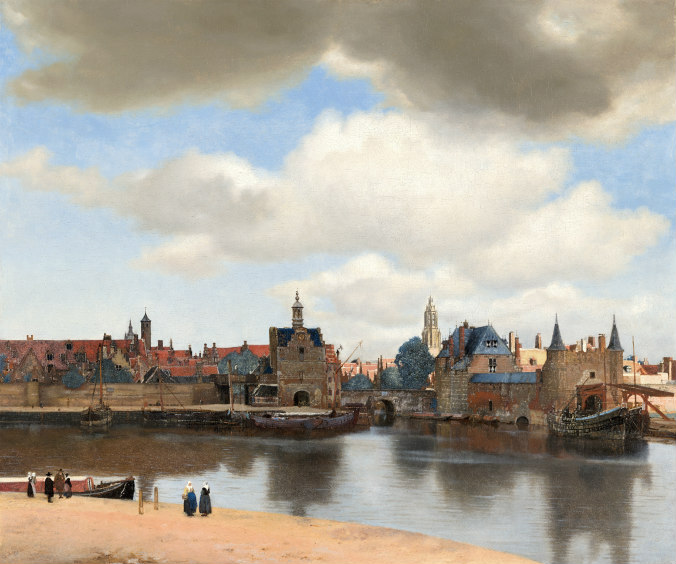
View of Delft (Zicht op Delft). An oil painting by Johannes Vermeer, painted circa 1659–1661.
Andrew Graham-Dixon, did your research expose a great contrast between the works of Vermeer and Caravaggio?
Yes, Caravaggio is perhaps the last really great painter of performative religion in the sense that Saint Francis of Assisi made the Christian religion something that everybody would perform. He encouraged children to make nativity models and people to do plays to make their religion public, to live it out in front of people, and Caravaggio is part of that. We know from accounts of the time that thousands of people would come before his paintings and they would cry and weep. It was very public, whereas Vermeer is the first really great religious painter of introspective post-Reformation religion. He’s part of this development that comes out through humanism, through Erasmus and other scholars who are disturbed by performative religion. They want everyone to be able to read and to be able to internalise the message of Christ. They think reading is the serious way to get to God, not performing, and Vermeer is expressing this very Protestant idea. It’s the period of history where people begin to have their own private pews in church, just reading the Bible and not listening to the preacher.
Vermeer’s moment is when religion is becoming less public and more private?
He is one of the first great painters of this. Even the group that meets in his house are meeting quite privately. They’re actually Bible reading groups, particularly the New Testament. They would begin at the beginning and end at the end, four times a year, and in their meetings they would discuss and discuss, talk and talk. Music was their only form of performance, symbolising that after all the talking, debate and discussion, we come together to agree with one singing voice. Maybe Caravaggio and Vermeer have become so popular because they embody two of the most vital and important dynamics in the history of Western civilisation over the last 500 years.
In their works they showed themselves to be masters of light. Perhaps this is why the dealers tried to sell Vermeer’s work as by Rembrandt?
The only case we really know where a Vermeer painting was sold as a Rembrandt was an unscrupulous dealer in Paris who wanted to ingratiate himself with the Holy Roman Emperor, and he retouched the famous “Girl Reading a Letter”. He painted out the background, and you could just about with your eyes half closed imagine that this is a Rembrandt.
Why is Vermeer so fascinating to us?
30 years ago I made a misguided film about Vermeer, but the one thing that I got right in that film was I kept saying to the camera, “These paintings have the feeling of religious paintings to me, but I can’t see what the religious context is, I can’t see how they could be religious paintings.” I’ve spent the last 30 years, especially the last seven or eight years, really trying to understand what that religious context was. People have criticised me for my argument that the “View of Delft” is actually a vision of the New Jerusalem as Vermeer’s group understood this: a vision of the everyday world that we inhabit transformed by the light of God. The moment of lived experience where everything seems charged with beauty and meaning.
Vermeer is also very precious because there are very few paintings, all instantly recognisable as uniquely his?
People have always known that Vermeer is unique, ever since Théophile Thoré rediscovered him and called him the Sphinx of Delft. At their best they’re every bit as extraordinary as the paintings of Rembrandt or Frans Hals. So why do we not know anything about him? was constantly the question. There’s something extraordinary going on, and it’s my belief that I’ve discovered what that something was. And he was indeed unique.
Why?
Because he was the only painter, as far as I’m aware, who painted for this particular wonderful group of liberal Protestants who call themselves Remonstrants, or Collegiants in their other manifestation. The uniqueness of the painting is mirrored in the uniqueness in the milieu. Everything is about the milieu. Whether it’s Caravaggio or Poussin, whoever it is, if you can really understand the milieu that leads to the creation of a particular picture or a particular group of pictures, you always have a much greater understanding. In Vermeer’s case, it’s too symmetrical to be a coincidence. This unique painter whose pictures seem blessed by divine light, whose works have this particular character of meditation and contemplation. Then you find they’re painted for the milieu of the house next to the secret church of this religious movement, and the religious movement is entirely about contemplation and meditation, the things that we see mirrored in Vermeer’s paintings.
Why did he make his paintings for just this one family?
Because he is himself a holy man and a painter. I would compare him to Fra Angelico, the great painter of San Marco, who is simultaneously a painter and a member of the Order of Friars. The same is true of Vermeer. He’s a deeply committed member of that religious group. He has no interest in money, no interest in fame. He doesn’t want, like Rembrandt, to paint the portraits of the Stadholder or such and such famous rich person. He’s probably reading the “Imitation of Christ” by Thomas à Kempis, in the first page of which we read, do not seek for money or fame or glory, only dedicate yourself to God. So he paints for these people; and only for these people.
Surely very occasionally he paints for someone else?
Yes, but usually it’s someone also who shares the same religious beliefs. There’s only a couple of paintings done in his whole career that seem to be purely secular. He’s possibly spending a great deal of time himself meditating and praying, so that would be why there are so few paintings.
“The Dutch Golden Age is probably the worst name ever given to a period in history by historians. It’s not a golden age. It’s an age of blood.”
Andrew Graham-Dixon, why is Vermeer so important even though he only painted a few apparently non-religious small works?
Perhaps the greatest miracle of Vermeer for me is that this very small group of maybe 24 paintings that were owned by the family are all sold in one auction in 1696 in Amsterdam. Within five years the name of the artist has been completely forgotten. These objects are just drifting through the art market, through the world, without any brand. They just exist. And yet they are so beautiful that nobody ever says, “Oh, don’t bother with that, just put that in the rubbish.” They were kept, without knowing who they were by. Maybe God’s responsible for that.
Why do you dedicate so much of your book to Vermeer’s environment and to what was going on in his country?
Because the conventional ways of seeing become entrenched and there’s a very particular stereotype way of seeing Dutch art. This idea came up that Dutch art is essentially materialistic. This is a myth that peasants, bakers and butchers are buying paintings, that it’s the first art movement for ordinary people who want paintings of things they can feel, of bread, of people getting drunk, of fine fabrics or beautiful fruit or flowers. That it’s all about material goods is absolute nonsense. There’s a tiny fraction of truth in it but it’s a small fraction of the truth. These people are engaged in far more interesting things than that, and my book is about these things that are never mentioned in any museum or collection of Dutch art.
Such as?
At the same time as Vermeer is growing up, in the 1630s/40s, Central Europeans – particularly from just east of the Netherlands all the way to Bohemia and Czechoslovakia – are experiencing the worst wars in the history of humankind. This has been preceded by atrocious wars of religion in France that have killed millions of people. During Vermeer’s lifetime, half to perhaps even two-thirds of the entire population of what they call the German lands are killed in a senseless war between Protestant and Catholic The Dutch themselves have fought for their freedom to be a nation from the Spanish in a bitter awful war called the 80 Years’ War which has resulted in the deaths of entire civilian populations: bombed, invaded, sacked, looted, pillaged, murdered. It’s blood on blood on blood. The Dutch Golden Age is probably the worst name ever given to a period in history by historians. It’s not a golden age. It’s an age of blood. But in 1648, finally peace is declared.
Coinciding with the beginning of Vermeer’s career?
Yes, exactly, and from then till 1673 there’s this extraordinary golden moment of peace and hope. At the same time as some of the greatest paintings in history are being made, among them those of Vermeer, we also find the birth of these extraordinary religious movements that I write about in my book, that have been more or less completely forgotten but which have a huge influence on the development of European culture and civilisation. Vermeer has another patron, not the couple who commissioned most of his pictures, who is the spiritual father of the Collegiate Movement. That man, Adrien Paets, is the direct patron of Pierre Bail. He has a huge influence through Bail on Voltaire. He has a huge influence through Voltaire on the dawn of the Enlightenment, on the birth of human rights, on abolition of slavery. There’s an astonishing historical role played by these people that’s been completely forgotten, and Vermeer is at the centre of that, painting these pictures which are the visual equivalent of their political and religious dreams of peace. The English, the French and the Germans have written the Enlightenment as if it was our story, when in fact it’s also the Dutch story.
In your book about Vermeer as an artist you rebuilt a whole part of history that had been almost forgotten?
Less forgotten in France than in England, because one of the main sources for my research is a wonderful book called “Chrétiens sans Église”, written by a Fellow at All Souls College, Oxford, called Leszek Kołakowski. It was only ever published in French and Polish. I used to be married to a French lady so I can speak French, so I was able to read that book and it’s a brilliant account. He himself was a communist and he sees the ultimate failure of this religious movement of tolerationists as akin to the failure of communism, that it gets taken over by a tyrannical regime.
Why did this religious movement fail?
Louis XIV in a short answer. Maybe they didn’t fail, but in their immediate objectives they failed and they felt that they had failed, because they hoped to bring peace to Europe and they thought that if they showed the example of peace through trade and peace through cooperation that this would put an end to the desire of absolute monarchs, or tyrants as they would call them, still wanting to measure their success in territory. They naively hoped that they would persuade all the great powers to stop competing over territory and create a Europe that would be unified in peace, which we are still hoping for. Louis XIV was deeply offended by the Dutch Republic. He didn’t like the idea of a republic being so close to France, he didn’t like republics anyway, and he was jealous of the money that they were generating with trade. He was determined to take them and he took them. He managed to persuade Charles II, who was easily led, and the Munsterites, and with a triple movement he crushed Holland. Within a very short period of time, all of the heroes of my book die: Vermeer, Spinoza the philosopher, Adrien Paets the father of the Collegiate movement, Pieter van Ruijven, Vermeer’s patron. It’s not a coincidence that all these men die within one, two, three years of what they called the “Year of Disaster”, 1672. The year when Louis XIV invaded. It’s a tragic ending to my book, but I feel that there’s hope at the end.
Are you proposing that just as Matisse painted red fish during the First World War, Vermeer paints modest peaceful daily life to show that there is not only violence and tyranny but also poetry in life?
Absolutely, and the two paintings that are most significant of that would be “The View of Delft” and “The Little Street”, where what Vermeer paints is, if you like, nothing at all. It’s just a house. There’s a sky. But when you look more closely, you see the house is actually two houses, and that the people who own the house on the right have mended their wall, but they’ve also mended the wall of the person on the left, and those people have also mended their house. Vermeer had a preacher when he was a child and the preacher who was a member of this religious group said, “Religion is like a house, but everybody has to put a brick in. Each and every person has to put a brick. I mend your house, you mend my house.” We make each other’s houses, and then if you look up at the sky you realise that the clouds have just parted and the sun has come through and then you look down and you see that the children are playing underneath a bench – and it’s nothing. But to somebody who’s just lived through 80 years of the worst wars that humanity has ever known, this nothing is everything. This is paradise.
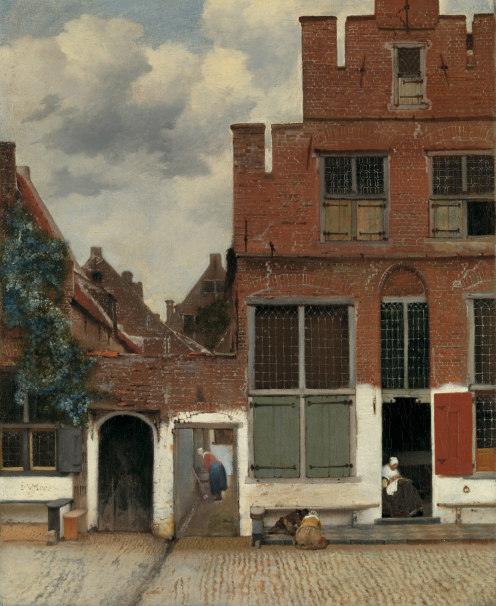
The Little Street (Het Straatje) is an oil painting by Johannes Vermeer, executed c. 1657–1658.
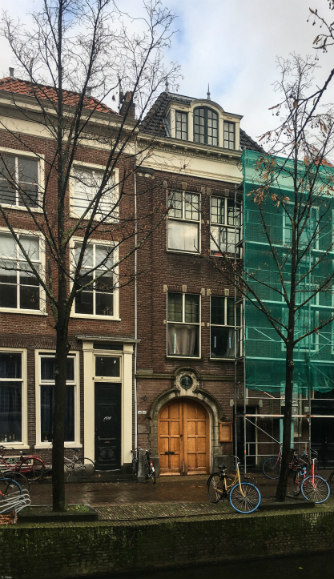
The modern site where Vermeer’s paintings once hung. Just behind its facade is the hidden Remonstrant Church, which still exists today.
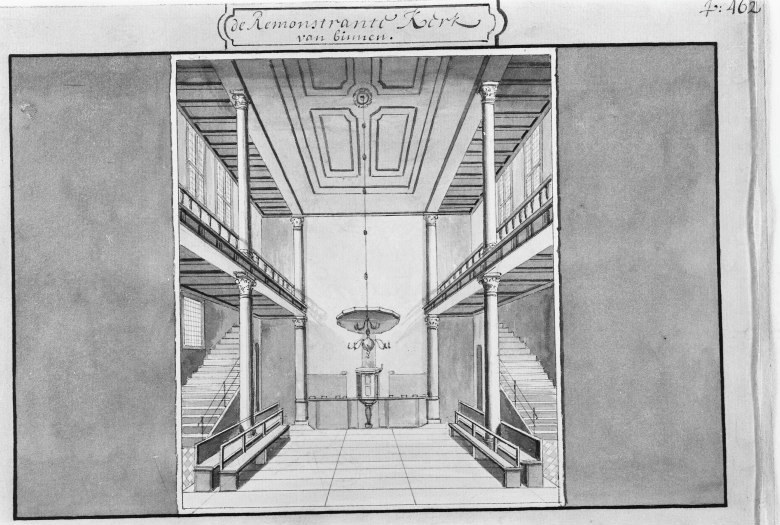
The interior of the hidden Remonstrant Church as it was in Vermeer’s time.
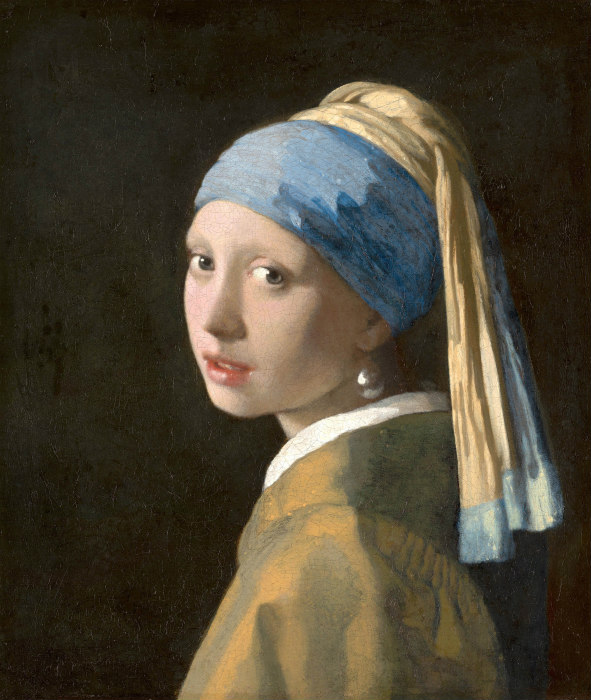
Girl with a Pearl Earring (Meisje met de parel). Oil painting by Johannes Vermeer dated c. 1665. Going by various names over the centuries, it acquired its present title towards the end of the 20th century.
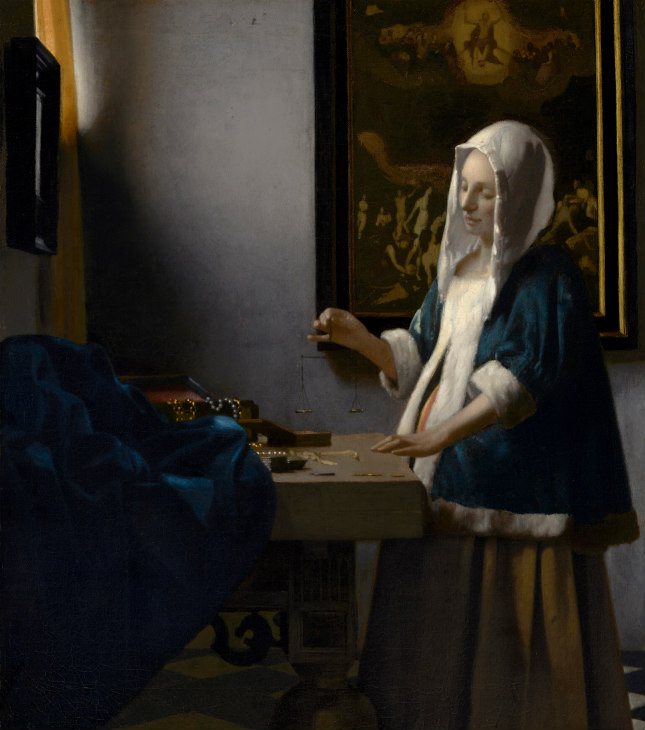
Woman Holding a Balance (Vrouw met weegschaal), also called Woman Testing a Balance, oil painting by Johannes Vermeer completed c. 1662–1663.
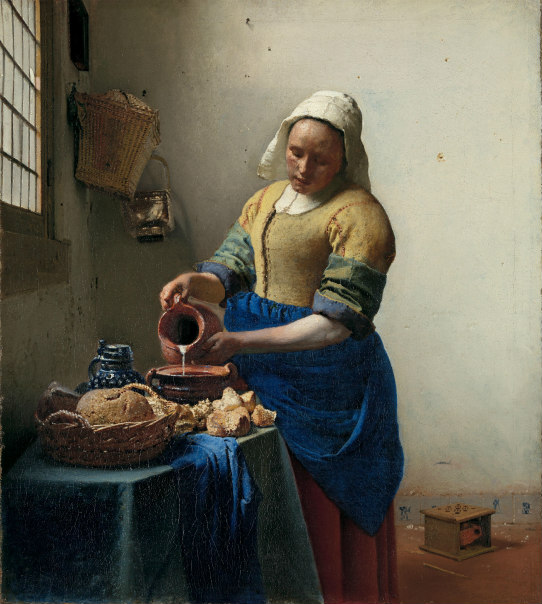
The Milkmaid (De melkmeid or Het melkmeisje), an oil-on-canvas painting of a domestic kitchen maid by Johannes Vermeer, estimated completed circa 1658.
“I’m a profound Collegiant. There’s not many of us now. I believe in universal tolerance.”
Andrew Graham-Dixon, did you dedicate almost all your life to the world of art because you think art is an important vehicle of peace in this world that never seems to lose the vice of war?
Everything one does has its own purpose so I can’t generalise about my writing about art. When I was writing my book about Caravaggio I was struggling a lot in myself, and I was writing about Caravaggio and the way in which he also had terrible struggles inside and managed nonetheless to express something very beautiful in his work. I found that writing about Caravaggio really helped me, whereas with this book I didn’t feel in the same way personally bound up in it. I promised that I would try to write something about Vermeer but I couldn’t for many years because I didn’t find anything new, and then suddenly I saw one connection and from there I realised within about two weeks that there were hundreds of these connections and that I had perhaps found his milieu. It felt to me like it had been given to me to write this book about peace and about love. It didn’t feel like it came from in me, it came from outside somewhere.
Do you already have a new project in mind?
There is something else, yes, but I can’t talk about it because it’s very sensitive for public information. With a friend of mine, about 12 years ago, we discovered a painting that I thought was possibly by a very famous artist, but had no evidence. We’ve kept kind of looking at this picture and we now know that it is indeed certainly from the milieu of that very famous artist, and it has a great bearing on some of that artist’s other work. I’m writing a book about this previously unknown painting, and I’ll be allowed to announce it in January of next year.
After you write your books with this deep involvement with the artist and his period do you forget them and move on to someone else?
I don’t completely forget them, but I put them to one side. Vermeer ended up surprising me by how big it became because I didn’t know about these connections, with the French Enlightenment in particular, at all until fairly late on. So it kept growing.
With your classic education at Oxford and the Courtauld Institute, do you describe yourself as a historian, or an art historian, or an art detective?
When I was at school, in my last year, I won the History prize and the prize for English. I went to university to read English and my History teacher was very disappointed. He’s now 85, and he’s the first person I tried to send my book to, so he can see I am a historian after all, because I think the Vermeer book is more a book of history than anything else. I am most interested in the history of ideas, and I think paintings are ideas. Painting is part of the history of ideas, I don’t see it as being part of the history of luxury objects or decoration. Even Matisse’s Goldfish are part of history of the ideas, and this is more understood in France where there’s been this succession of great writers who are also art historians. In England, only Ruskin did that.
Why do art historians argue passionately about seminal figures in art many years after they have died?
That proves that they’re part of the history of ideas. Otherwise, why would people get so upset? (laughs)
Why is your Vermeer book really so revolutionary and so different to what has been written before?
There was no unified theory before. There is no strong coherent view of Vermeer that you can put against mine. My book has been criticised for being too definite, for being too precise and too specific and saying this is his milieu and this is what his paintings mean – which I don’t mind at all. After all the Remonstrants were apostles of the idea of toleration, so I tolerate your ideas if they’re different from mine. The biggest difference is that the various forms of consensus that existed before are very masculine and a little bit in that traditional mould of being a little bit contemptuous to women. For example one very well-known Dutch art historian wrote a book about Vermeer and says that the milkmaid is a painting that tells us that Vermeer’s patron had sexual fantasies about his servants, and that Vermeer painted this sexy milkmaid as a picture to arouse Van Ruijven’s fantasies. For me, that is horror. That’s crazy. Of course it isn’t that. It’s a wonderful painting about the importance of charity, and it’s a painting all about the Remonstrant’s desire to make bread pudding and give it to the poor – so it couldn’t be more opposite.
In your book you try not to just talk about Vermeer or about the wars, but about the whole situation?
That is exactly what I try to do. I try to talk about as much of everything that I can see that would connect to the paintings and the milieu as possible. It was a long process because I’m not an expert in Dutch art, so when I was writing the book I had to spend two or three years just reading about Dutch history. When I discovered the religious group that I felt were connected to Vermeer, I then had to spend three years reading Dutch theology. Six or seven years of research of the book, and not at all reading about Vermeer. That’s why I say it’s as much a book of history.
Would you say that Europe is made of two very different ways of thinking, Catholic and Protestant?
That’s true, and on the other hand, if you look at Vermeer’s milieu, they are their greatest dream. The Remonstrants and the Collegiants come into existence precisely because everywhere they look they see wars between Protestants and Catholics. Their great message is, let us Protestants heal our differences and let us heal our differences with the Catholics. What they hope and dream of seeing is a Christian world in which it doesn’t matter. You can be a Mennonite, Lutheran, a Calvinist, you could be a Jesuit, a Jansenist Catholic, a Camaldolese Catholic, you can be whatever you want, but we agree that the central principle of Christianity is love thy enemy, love thy neighbour, thou shalt not kill. We are all on the same side, even if we have small differences of belief about predestination or about the wafer, whether it really is the body, whether the wine really is the blood, and so on. Can we not just put these beliefs aside and agree to believe in Jesus and his principles?
They reconcile all these different ways of worshipping one God?
The Collegiants even say, as far as they’re concerned, you don’t have to believe in God, you only have to believe that what Jesus said contains the salvation for people. The Dutch are in between the extreme Catholics of Spain and the extreme Protestants of England. These Dutch, the Dutch I’m interested in, are hoping to make peace between everybody. Arminius, the founder of the Remonstrant movement, even expands it beyond Christianity. In his famous speech in 1607, the equivalent of Martin Luther King’s great speech, the great speech of the 17th century, he tries to encourage the Jews and the Muslims to stop making war with each other, just as much as we stop making war on the Jews. He encompasses all the religions and says that we must just stop fighting over religious difference. Full stop.
Are you a religious person?
I’m a profound Collegiant. There’s not many of us now. I believe in universal tolerance.
Did you come to this conclusion before or after studying Vermeer?
While I was writing the book I became converted. I love the Remonstrants because I met the Remonstrants in Rotterdam and a very nice Remonstrant gentleman who for nothing agreed to look in the archives for me because his Dutch was better than mine actually found the most important piece of new information in my book, which is that the house of Vermeer’s patrons was the Porter’s Lodge directly in front of the secret Remonstrant Church in Delft. I only found this out having written a whole book about the Remonstrants and Vermeer. I didn’t know this central piece of information that all Vermeer’s paintings hung in the house next to the church of the Remonstrants, and I had to actually change my manuscript. I’ve got a very soft spot for the Remonstrants because they’ve helped me so much.
Andrew Graham-Dixon thank you very much for this conversation.
Portrait of Andrew Graham-Dixon by Aliona Adrianova
ENJOY THIS INTERVIEW? SHARE IT WITH A FRIEND